
My Grace Is Sufficient for You: That the Power of Christ May Rest Upon Me
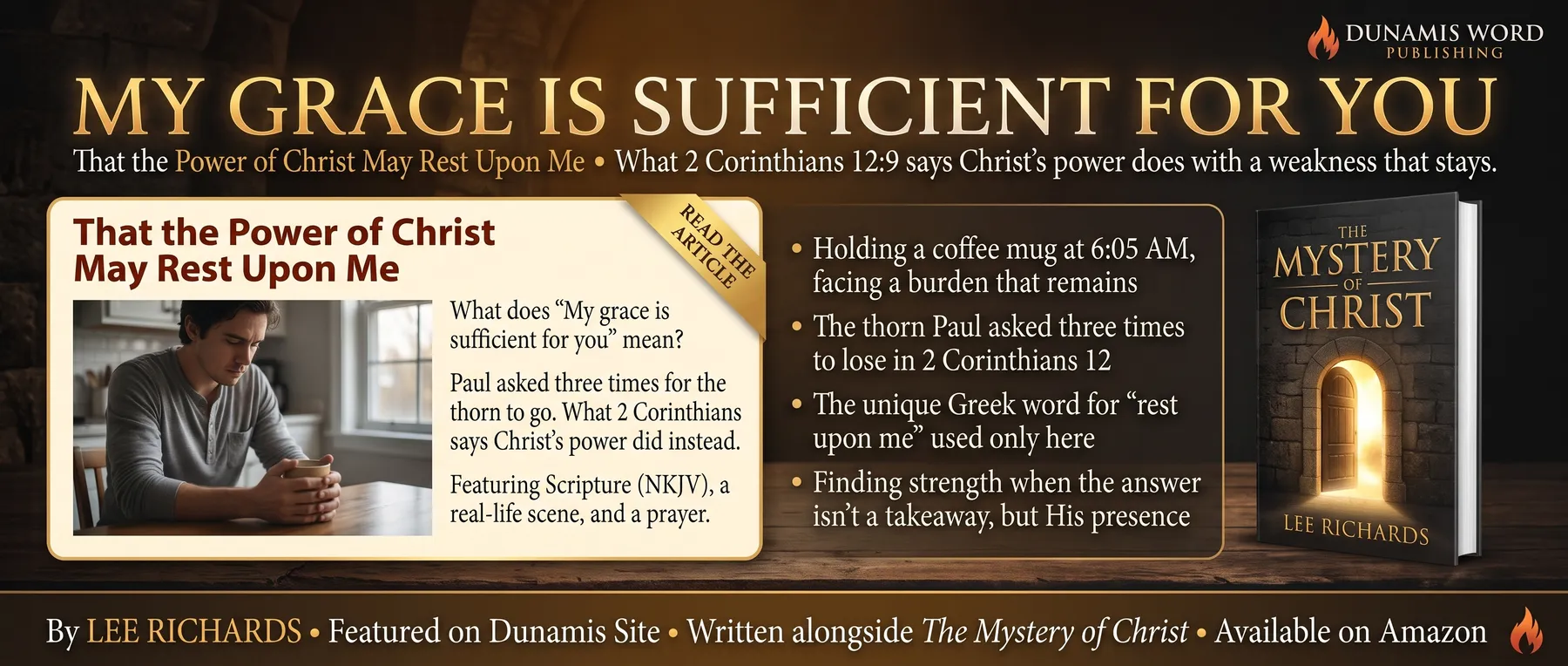
It’s 6:05 on a Tuesday, and you’re holding the coffee mug with both hands now.
You started doing that in the spring, after the second neurologist said “progressive” and slid a brochure across the desk. The left hand is worse. Some mornings the coffee rings the inside of the mug like a little bell before you can get it to your mouth.
You’ve asked Him to take it away. At the altar in April, with the pastor’s hand on your shoulder. In the parking garage after the second appointment. And last night, in bed, with that hand pressed flat under your leg to hold it still while you prayed.
It’s still here. So before work you typed a verse you’ve heard your whole life into the search bar on your phone, one thumb at a time.
The short answer: “My grace is sufficient for you” is the Lord’s answer to Paul after Paul asked Him three times to take his thorn away. The thorn stayed. What came instead was a promise: “My grace is sufficient for you, for My strength is made perfect in weakness” (2 Corinthians 12:9). His grace is enough for you in the weakness, and the same verse tells you what His power does there. It does not wait for the weakness to leave. It rests on the one who still has it.
The Man Who Had Been to Paradise
Paul didn’t want to write this part of the letter. “It is doubtless not profitable for me to boast. I will come to visions and revelations of the Lord” (2 Corinthians 12:1).
Fourteen years earlier, he says, a man in Christ “was caught up into Paradise and heard inexpressible words, which it is not lawful for a man to utter” (2 Corinthians 12:4). He writes it in the third person, the way you’d hold something hot by the handle.
Then, in the next breath, he comes back down to earth: “a thorn in the flesh was given to me” (2 Corinthians 12:7).
He never says what it was. That may be a mercy. It lets the verse sit down next to the thing you carry.
What he does tell you is what he did with it. “Concerning this thing I pleaded with the Lord three times that it might depart from me” (2 Corinthians 12:8).
Three times. The man who had heard words in Paradise asked for the same thing three times, with the same thorn still in him.
He Answered
Put him where he was the third time. The same request. Take it away. The thorn still in him while he asked.
“And He said to me” (2 Corinthians 12:9).
Stop there for a second. Paul got an answer. It wasn’t the one he asked for, but it was not silence, and he writes “He said” in a tense that means the word was spoken and still stands.
“My grace is sufficient for you, for My strength is made perfect in weakness.” Not “your thorn is gone.” Not “try again.” Grace that is enough, and strength that comes to its full work in the very place Paul wanted removed.
If you’ve wondered whether your prayers even reached Him, read how God bends to hear one person’s cry. Paul’s did.
The Power That Pitched Its Tent
Now look at what Paul does next. He doesn’t ask a fourth time. “Therefore most gladly I will rather boast in my infirmities, that the power of Christ may rest upon me” (2 Corinthians 12:9).
“Rest upon” is one Greek word, episkēnoō, “to pitch a tent over, to tent upon.” It is used only here in the entire New Testament.
It’s built on a smaller word, skēnoō, “to pitch a tent, to dwell,” and you know that word even if you’ve never seen it. It’s the one John reached for when he wrote, “And the Word became flesh and dwelt among us” (John 1:14). Dwelt: pitched His tent.
And one more thing in the same verse. “My strength” and “the power of Christ” are the same Greek word, dynamis, “power.” The power the Lord promised Paul in the first half of the verse is the power Paul says will pitch its tent over him in the second half.
So picture it the way a man who made tents for a living would have (Acts 18:3). The weakness is the ground. Christ doesn’t wait for the ground to become solid before He drives the stakes. He pitches His tent right there, over the man with the thorn, and the canvas covers the place it hurts.
So this is what it means for you. His power is not waiting down the road for the morning your hand finally goes still. It comes to rest on the one who still has it. So you can stop reading the thorn’s staying as proof that His power has not come, and stop trying to get steadier first before you let Him cover you. The tent goes up over the weakness. That’s where He said He’d put it.
The Word who pitched His tent among us in flesh is the same One Paul calls “Christ in you, the hope of glory.” You can read more on what Colossians 1:27 means by Christ in you.
When the Word Catches
If He wanted me up there, He’d have fixed my mouth by now.
You think it at 6:40 on a Tuesday evening, standing at the lectern in the empty sanctuary with the lights at half. The pastor asked you in October to read Luke 2 on Christmas Eve, and you said yes before your mouth could stop you. You’re forty-six, you run a forklift on second shift at the tile warehouse, and you’ve stammered since Mrs. Daley’s reading circle in second grade.
You’ve asked Him to take it. On your knees at nineteen. In the truck before job interviews. Every Christmas Eve from the back row.
You smooth the page flat. A sticky note on the lectern edge says 2 Corinthians 12:9 in your own block letters.
“And it came to pass in those days,” you read, and that part comes out whole.
You get as far as “the city of David, which is called” and the B catches behind your teeth and holds.
You don’t back up to the top of the chapter. You keep your hand on the page. The furnace kicks on somewhere under the floor.
“Bethlehem,” you say, and you keep going.
Where the Thorn Meets You First
Here’s the one thing to do. Find the place where the thorn meets you first each day: the mug, the pill organizer, the mirror, the steering wheel. Put 2 Corinthians 12:9 there.
Tomorrow, when you get to that place, read the verse out loud. Tell Him in one plain sentence where it’s hurting today. Then say, “Your grace is enough for today. Rest Your power on me here.” And do the next ordinary thing with the hand that shakes.
That’s all. You aren’t asking a fourth time. You’re standing under the answer He already gave.
Scripture to Keep When the Thorn Stays
“And He said to me, ‘My grace is sufficient for you, for My strength is made perfect in weakness.’” (2 Corinthians 12:9)
“For when I am weak, then I am strong.” (2 Corinthians 12:10)
“But we have this treasure in earthen vessels, that the excellence of the power may be of God and not of us.” (2 Corinthians 4:7)
“My flesh and my heart fail; But God is the strength of my heart and my portion forever.” (Psalm 73:26)
“And the Word became flesh and dwelt among us” (John 1:14)
A Prayer for When It Has Not Gone Away
Father, I have asked You to take this away, and it is still here. You know how many times I have asked. Thank You that You answered me, even when the answer was not the one I wanted. Your grace is sufficient for me. Your strength is made perfect in my weakness. I will stop waiting to be strong before I come to You. Let the power of Christ rest upon me here, today, in this place. In Jesus’ name, amen.
If you want to know the One whose power rests on you, The Mystery of Christ traces how He lives in you and how to hear His voice.
I heard you at the altar. I heard you in the garage. I heard you last night with your hand under your leg. I answered you, child, and I haven’t taken it back. My grace is enough for this morning. I’m not waiting for you to get steady. I’ve pitched My tent right here, over the hand that shakes.
The thorn stayed. So did He, and His power has pitched its tent over the place where it hurts.
Keep Reading
Scripture taken from the New King James Version®. Copyright © 1982 by Thomas Nelson. Used by permission. All rights reserved.